


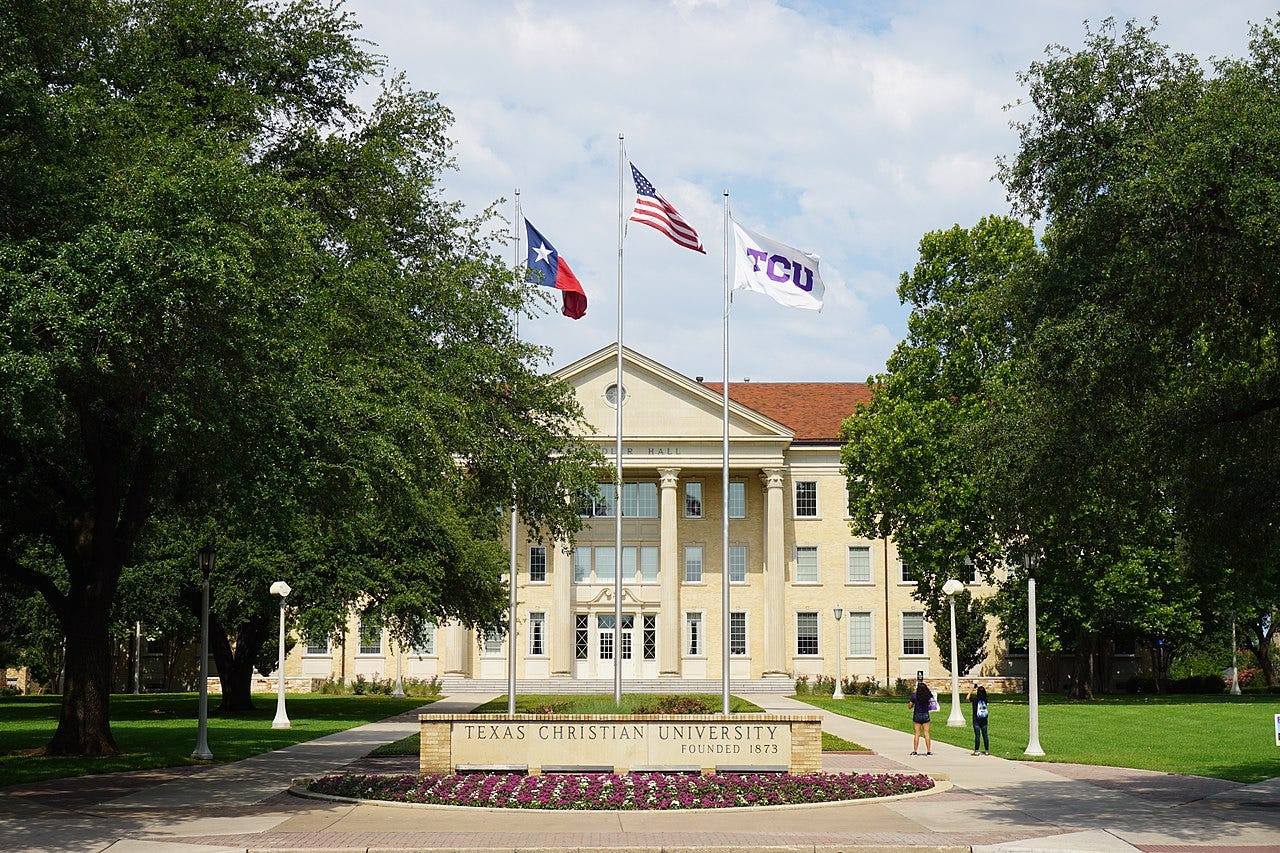
Photo: Michael Barera via Wikimedia Commons.
Texas Christian University, a private school, is closing its departments for Women and Gender Studies and Comparative Race and Ethnic Studies. They are combining these programs into the English department. While the school said it was due to low enrollment, this decision is happening as a clear political effort to shut down Diversity, Equity, and Inclusion (DEI) programs across the country.
This is more than just a change in departments. It shows a huge step backward in how we approach ideas. You know, just this Monday, I was having lunch with John Dallas, founder and CEO of Enclave Academy, a not-for-profit focused on strengthening essential thinking skills for leaders. We were discussing this exact moment: the trending degradation of deep curiosity and inquiry—that intellectual fire that was the hallmark of American-brand enlightenment our Founding Fathers and Mothers used as the brick and mortar to build our country. When we start shutting down avenues of challenging thought, we lose the capacity for the kind of complex analysis leaders desperately need.
That’s why the political pressure is so concerning. State governments, and the atmosphere they create, are now using threats to funding to force public schools and even private ones like TCU to get rid of programs that focus on marginalized groups.
The systemic attack on critical inquiry
Let’s look at the scope. Since 2023, nearly two dozen states have seen anti-DEI legislation enacted into law. These laws do not just ask schools to be “neutral,” they are specifically designed to eliminate DEI offices, ban mandatory diversity training, and prohibit diversity statements in hiring. The main tool used is the budget. By threatening to pull essential state funding from major public universities, politicians ensure schools follow the new rules. Texas, for example, has been a leader in this political push.
The resulting effect is a powerful pressure that reaches beyond public campus gates and into places like TCU. When state leaders actively criticize curriculum and call programs “radical,” it creates a real problem for administrators. They feel they must act to protect their schools’ reputations and their ability to operate in that state. What follows is not an honest academic decision, but a forced step backward for learning.
The retreat from rigor
When you cut a Women’s Studies department or a Race Studies department, you are severing a pipeline of specialized knowledge. These fields, often wrongly dismissed as unnecessary, are key to understanding modern society, public policy, and global history. They train the legal experts, urban planners, public health researchers, and business leaders who need to analyze inequality, bias, and power structures.
The costs are immediate and serious. First, we face a “brain drain” and self-censorship. Research shows that faculty, especially LGBTQ scholars and scholars of color, are already considering moving from states with these bans. Furthermore, many academics are afraid to teach certain topics or are decreasing class discussions for fear of backlash.
You cannot maintain intellectual strength by pushing away your most diverse thinkers or forcing them to dilute their teaching.
Second, we lose crucial research. The academic studies that come out of these departments inform public policy on health disparities, income inequality, and corporate culture. By shutting down these specialized research centers, we hurt our ability to address the real-world problems facing a rapidly diversifying nation.
Third, we hurt the talent pipeline. DEI offices and centers are essential for student retention. They provide the support and sense of belonging that help underrepresented students, including students of color, veterans, and first-generation scholars, succeed and graduate. When those support systems vanish, these students are less likely to thrive, which limits the entire nation’s talent pool.
The long-term national setback
If the goal is truly intellectual and economic strength, dismantling DEI is a catastrophic error.
Diversity in thought and experience is an economic and intellectual advantage, not a liability. Historically, the convergence in wages and jobs for marginalized groups, driven largely by educational access, accounted for a massive 41.5% of the nation’s growth in GDP per capita between 1960 and 2010.
By limiting access to critical frameworks that address systemic issues, and by creating environments where diverse scholars and students are unwelcome, we are consciously choosing to limit our future innovation, creativity, and problem-solving capacity. We are trading long-term national strength for short-term political victory.
The ultimate price of these policies will be paid not in budget cuts today, but in the intellectual stagnation of the next fifty years.


